
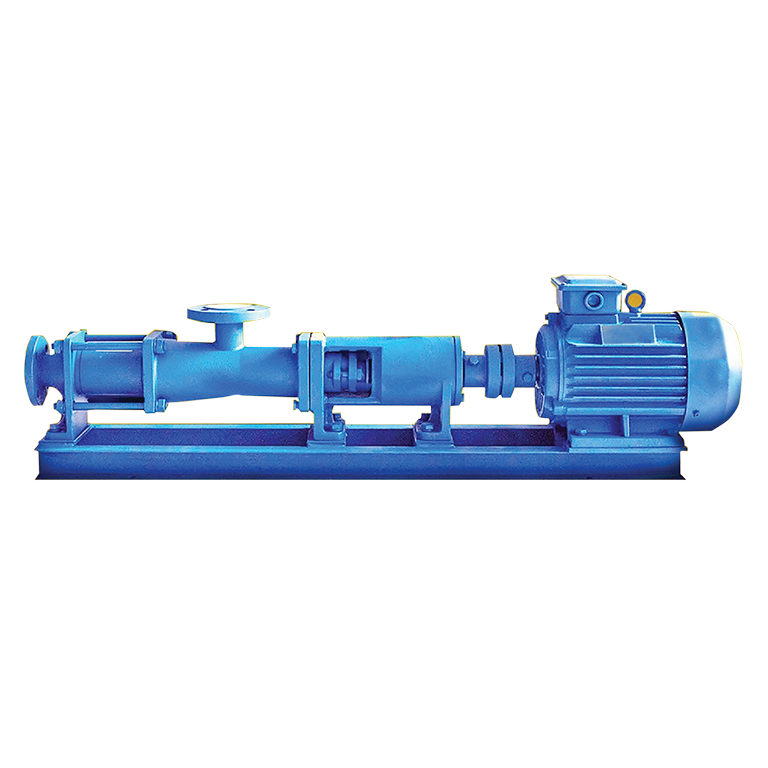
GE Type Single Screw Pump
Product Advantage
The GE-type single-screw pump is a new type of pump that operates on the principle of helical engagement and volumetric displacement. The main working components are the eccentric screw (rotor) and the fixed stator. Due to the special geometric shapes of these two components, they form separate sealing chambers. The medium flows uniformly in the axial direction, with low internal flow velocity, constant volume, and stable pressure. As a result, it does not generate eddy currents or agitation. The output pressure for each stage of the pump is 0.6 MPa, and the head is 60 meters (for clear water), with a self-priming height generally around 6 meters. It is suitable for conveying media with a temperature below 80°C (special requirements can reach up to 150°C).
The stator is made of various elastic materials, making this pump suitable for the transportation of high-viscosity fluids and media containing hard suspended particles or fibers. It has characteristics that other pump types may not handle. Its flow rate is proportional to the speed.
The transmission can be achieved through direct coupling or using devices such as variable-speed motors, V-belts, gearboxes, etc., for variable speed.
This pump has few parts, a compact structure, small size, easy maintenance, and the rotor and stator are the vulnerable parts. The structure is simple, facilitating installation and disassembly.
Product Advantage
The operating speed can be high or low, and the rated pressure at the pump outlet can
increase with the number of stages. For each additional stage, the pressure increases by 0.5
MPa, making it versatile.
- Environmental Protection: Conveyance of industrial wastewater, domestic sewage, and sludge with solid particles and short fibers. Especially suitable for equipment such as oil-water separators and plate and frame filter presses.
- Shipbuilding Industry: Conveyance of wheel bottom cleaning, oil-water, oil residue, oily wastewater, and other media.
- Petroleum Industry: Conveyance of crude oil. In recent years, it has been particularly successful in pumping mixtures of crude oil and water from depths of up to kilometers underground, as well as mixtures of coalbed gas and water, significantly reducing the cost of mechanical oil and coalbed gas recovery. When an oil field reaches its later stages, the use of screw pumps to inject polymers into the reservoir significantly increases oilfield recovery.
- Medical and Daily Chemicals: Conveyance of various viscous pastes, emulsions, and various ointment cosmetics.
- Food Canning Industry: Conveyance of various viscous starch, cooking oil, honey, sugar sauce, fruit pulp, cream, fish paste, and their by-products.
- Brewing Industry: Conveyance of various viscous fluids for fermentation, thick liquor tanks,
various sauces, pulps, and viscous fluids containing solid particles. - Construction Industry: Spraying and conveying of cement slurry, lime slurry, coatings, and pasty bodies.
- Mining Industry: Conveyance of underground and slurry water containing solid particles in mines to the surface.
- Chemical Industry: Conveyance of various suspensions, oils, various colloidal pulps, and various adhesives.
- Printing and Paper Industry: Conveyance of high-viscosity inks, PVC polymer pastes for corrugated paper, and pulps of various concentrations and short fibers.
| No. | Pump Model | Rotating speed (r/min) | Flow Rate (m³/h) | Particle Diameter (mm) | Maintenance Length (mm) | Pressure (Mpa) | Power (kw) | Head (m) | Inlet Outlet diameter (mm) | |
|---|---|---|---|---|---|---|---|---|---|---|
| 1 | GE20-1 | 960 | 0.8 | 0.6 | 0.75 | 60 | 1.5 | 25 | 25/25 | |
| 2 | GE25-1 | 960 | 2 | 06 | 1.5 | 60 | 2.5 | 30 | 32/25 | |
| 3 | GE25-2 | 960 | 2 | 1.2 | 2.2 | 120 | 2.5 | 30 | 32/25 | |
| 4 | GE30-1 | 960 | 5 | 0.6 | 2.2 | 60 | 2.5 | 35 | 50/40 | |
| 5 | GE30-2 | 960 | 5 | 1.2 | 3.0 | 10 | 2.5 | 35 | 50/40 | |
| 6 | GE35-1 | 960 | B | 0.6 | 3.0 | 60 | 3 | 40 | 65/50 | |
| 7 | GE35-2 | 960 | 8 | 1.2 | 4.0 | 120 | 3 | 40 | 65/50 | |
| 8 | GE40-1 | 960 | 12 | 06 | 4.0 | 60 | 3.8 | 45 | 80/65 | |
| 9 | GE40-2 | 960 | 12 | 1.2 | 5.5 | 10 | 3.8 | 45 | 80/65 | |
| 10 | GE50-1 | 960 | 20 | 0.6 | 5.5 | 60 | 5 | 50 | 100/80 | |
| 11 | GE50-2 | 960 | 20 | 1.2 | 7.5 | 120 | 5 | 50 | 100/80 | |
| 12 | GE60-1 | 960 | 30 | 0.6 | 11 | 60 | 6 | 60 | 125/100 | |
| 13 | GE60-2 | 960 | 30 | 12 | 15 | 120 | 6 | 60 | 125/100 | |
| 14 | GE70-1 | 960 | 45 | 0.6 | 15 | 60 | 8 | 70 | 150/125 | |
| 15 | GE70-2 | 720 | 45 | 12 | 18.5 | 120 | 8 | 70 | 150/125 | |
| 16 | GE85-1 | 720 | 65 | 0.6 | 15 | 60 | 10 | 80 | 150/150 | |
| 17 | GE105-1 | 500 | 100 | 06 | 22 | 60 | 200/200 | 15 | 110 | |
| 18 | GE135-1 | 400 | 150 | 0.6 | 37 | 60 | 20 | 150 | 250/250 |
Considerations:
1. The performance data in the performance table are based on testing with clear water at 20°C, with a viscosity of 1 mm²/s.
2. When the pump is conveying a high-viscosity medium with particles, the pump speed must vary based on the nature of the medium.
3.When the pump is conveying media with different levels of abrasiveness, the pump speed must also vary.
Choose Pump Speed Based On Viscosity of the medium
| Medium Viscosity | 1-1000 (CST) | 1000-10000(CST | 10000-100000(CST) | 100000-1000000(CST) | Rotating speed (r/min) | 600-1000 | 300-600 | 200-400 | 100-200 |
|---|